Office
Screen comfort, vertical illumination and daylight-responsive zones shape a useful workplace scheme. Recessed and linear systems must coordinate with ceilings and future layout changes.
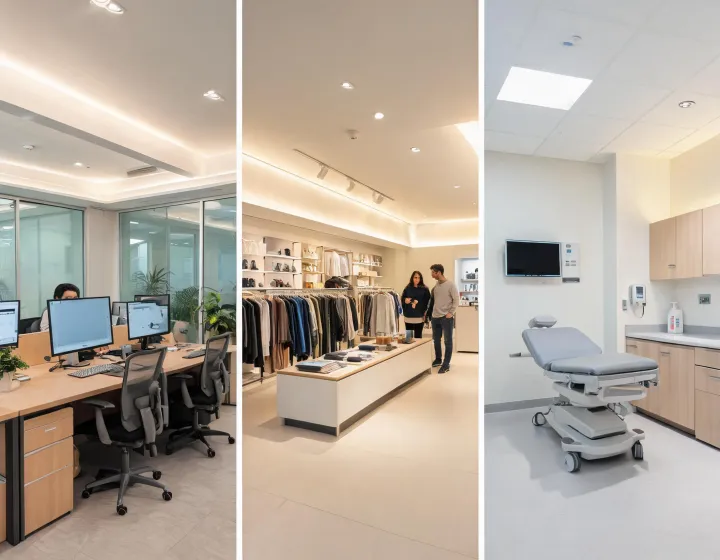
Select around the people, tasks and operating conditions in each space.
Screen comfort, vertical illumination and daylight-responsive zones shape a useful workplace scheme. Recessed and linear systems must coordinate with ceilings and future layout changes.
Beam control and color quality establish hierarchy without excessive brightness. Track flexibility, aiming and maintenance access matter as displays change.
Clinical tasks, patient comfort, cleaning and nighttime navigation create different requirements within one facility. Controls must be understandable to operators.
Teaching surfaces, screens, circulation and variable occupancy call for controlled glare and zones that teachers can operate without complex intervention.
Mounting height, vertical tasks, dust, impact and long operating hours make uniformity, IP/IK, thermal management and service planning essential.
Centralized controls can simplify portfolio policy and monitoring; distributed controls can improve local flexibility and isolate faults. Network ownership, commissioning capability and future zoning changes determine the more maintainable architecture.
Application guidance narrows options but does not certify a final design. Calculated results should be checked against current photometry, room geometry and the selected product configuration.
Roadway and area-lighting schedules should identify input service, typical surge environment, output-current requirement, maximum LED voltage, enclosure location and dimming or network interface. A 10 kV surge component is only one part of protection coordination; grounding, upstream devices, installation class and local exposure still affect the system response.
Warehouse high-bay projects add long operating periods, elevated ambient temperatures and frequent sensor transitions. Driver selection should account for thermal derating, case-temperature measurement location, occupancy-control sequence and the LED load across its operating range. A nominal 150 lm/W luminaire target does not determine the driver on its own because optical losses, current setting and thermal behavior affect system efficacy.
Commercial interiors emphasize low-end dimming, flicker response, acoustic behavior and emergency-system coordination. DALI-2 can support addressable commissioning, while 0–10V may reduce device complexity; project teams must still define off behavior, control-wire topology, responsibility for programming and what happens when a control signal is lost.
Integrated power stages support compact housings and controlled thermal interfaces, but a serviceable driver can reduce the scope of a future repair. Centralized control simplifies policy and monitoring, whereas distributed architecture offers local flexibility and fault separation. A useful schedule records these opposing benefits next to access, lifetime expectations and maintenance capability.
All values remain model and test-condition specific. IP rating does not establish chemical resistance, LM-80 describes LED package data rather than complete driver lifetime, and a dimming protocol name does not prove controller interoperability. Final approval requires current product documentation for the selected configuration and destination market.
Share plans, occupancy and control requirements.